2012 ഓഗസ്റ്റ് 21, ചൊവ്വാഴ്ച

Most Expected movies in Iffk2012 Part VI


      Tower

Directed by Kazik Radwanski

·         Canada 2012; 78 min
·         Original version: English
·         Genre: Drama


Synopsis

Derek, a 34-year-old man, lives at home with his parents in Toronto. Unlike his married brother who is expecting a baby, Derek is single and without a career, and although he aspires to become a graphic animator, he works part-time at his uncle’s construction company. Late at night, he wanders the streets alone and frequents nightclubs in search of companionship, until he meets Nicole and suddenly finds himself in an intimate relationship with her. When a neighbourhood raccoon becomes a constant nuisance by tearing up his family’s garbage, he sets out to catch it.

Press Quotes

Derek is certainly a tantalizing enigma, not only to the audience and the characters populating the movie but to himself as well.
Eric Kohn, Indiewire
Your Ad Here


Tower, which is impressive even beyond its ingenious low-budget engineering, represents a fruition for Radwanski. Where his shorts have a light, glancing quality, Tower sustains a strong and at times frightening sense of intensity. Its director jokingly refers to it as a “Toronto-set version of Taxi Driver,” albeit with less narrative pyrotechnics. It’s probably best described as a character study of a man who is an uncomfortable enigma to others and perhaps also to himself; Derek (Derek Bogart) is a would-be computer animator who lives in his parents’ basement and can’t seem to get a foothold in social situations.
“It’s a weird film,” says Radwanski, who shot Tower over six months with a cast of mostly non-professional actors for about $50,000 (the money came from various arts council grants). “I’m glad I was able to capture some of the feelings in the film before I forgot them. It’s always interesting when you take something that you love and put it out there for others to see.”
Both Radwanski and Montgomery are aware of the Locarno festival’s reputation as a haven for cinephilia – a place where people are more interested in the movies on the screen than what's being reported in the trades. “My understanding is that [Locarno] is the precise place for the sort of critical crowd that we want to see the film,” says Montgomery. “These are the people who can see it at the beginning and maybe sort of champion it from there.”
They already have at least one champion: Stacey Donen, a former programmer for TIFF and recently the Artistic Director of the Whistler Film Festival, who this week acquired Tower as the first film for his newly launched distribution company in Toronto. “We started College Street Pictures in part to cultivate and promote the next generation of Canadian filmmakers as innovative contributors to the international film scene," says Donen, who is planning on a fall release. “Tower reflects this. Kaz is a rarity and clearly he’s an uncompromising filmmaker.”
“We wanted to remain as hands-on with the film as possible,” adds Montgomery, “even though it’s finished. With College Street Pictures, we think we have that chance because it’s so new – their catalogue hasn’t even been established. Plus we know where Stacey lives and where he likes to get a beer, so we can always find him if we have to.”
That sense of community extends to MDFF’s online funding campaign, which offers a unique twist on the Kickstarter scenario beloved by independent filmmakers. Instead of soliciting donations to get their film off the ground, they’re asking for money to help polish the finished product. One of the items available on the website (indiegogo.com) is a wooden DVD case containing three MDFF shorts. It’s a nod to the company’s handcrafted roots (Radwanski’s family is in the construction business) and a comment on the increasingly ephemeral nature of film viewing and ownership.
“We plan to release the shorts online for free at some point,” says Montgomery. “The case is more of a gesture. It’s something that can be appreciated for the craftsmanship and the details, and the tactile feeling of picking it up and having an object.”
Your Ad Here
“We’re making these crude wooden cases in the hope that it’ll help us have a high-end thing,” adds Radwanski, who is undaunted by the possibility of crafting dozens of boxes by summer’s end. “Because every once in a while we sort of stop and realize that we’re about to show this movie in Switzerland to 1,000 people."
Locarno Review: An Awkward Loner Made Mesmerizing in the Canadian Feature 'Tower'
The anti-hero of "Tower."
More than once in "Tower," the discomfiting first feature from Canadian writer-director Kazik Radwanski, 34-year-old loner Derek -- memorably played by newcomer Derek Bogart -- issues a dubious refrain: "I don't want you to think I'm some sort of weirdo," he says. Of course, that's all anyone thinks of this squinty-eyed, cartoonishly bald and finicky bachelor as he juggles odd jobs while living with his parents. Getting uncomfortably intimate with Derek from the first scene of "Tower" until its last, Radwanski dares the audience to feel differently about him. It's no easy task.

Throughout the movie, Derek wears a distinctive frozen expression, his eyes locked in a distant gaze. Early on, after making the rounds at a nightclub and chasing a few women home, he awakes the next morning with a nasty red wound between his eyes. Never hidden from view, the injury is one of many merciless forces that turn Derek into an unseemly figure. Aided by cinematographers Daniel Voshart and Richard Williamson, Radwanski consistently frames his antihero in extreme close-up as he wanders through an empty life in which everyone fails to get a rise out of him.

A struggling animator whose greatest success is 13 seconds of a ridiculous animated short film that took him two months to complete, Derek wanders through a part-time construction job while evading advice from his helpless parents (John Scholl and Deborah Sawyer). These characters are never given names, possibly because they're so irrelevant to Derek as he continues to brush aside their efforts with eternal ambivalence. For no apparent reason other than boredom and desperation, he falls into an ill-fated relationship with an affable woman named Nicole (Nicole Fairbairn), who mistakes his alienating behavior for a kind of serene innocence.
Derek is certainly a tantalizing enigma, not only to the audience and the characters populating the movie but to himself as well.
Derek is certainly a tantalizing enigma, not only to the audience and the characters populating the movie but to himself as well. While "Tower" continually frustrates in its brash avoidance of a story to sustain its fascinating creation, Radwanski has an incredible eye for deepening his protagonist through images alone. Derek regularly stares down his reflection with palpable dread, rendering in physical terms what other screenwriters might attempt through dialogue. Whether contemplating his invasive wisdom teeth or desperately attempting to bury his facial injury with makeup in a moment both cringe-inducing and deeply funny, Derek struggles through his world with symbolic moments that reflect his urgent need to pull things together.

However, even as "Tower" grows increasingly frantic, there's not quite enough activity here to sustain a feature. Outside of an irreverent breakup scene that turns unexpectedly touching, at just under 80 minutes, it hardly pushes the uneasiness any further than the bare outline of a plot can carry it.

The closest recent point of comparison for "Tower" is Ronald Bronstein's "Frownland," which also followed a perpetually antsy and confused character with relentless detail. But in that case, the movie eventually opened up to chart a path of character development that "Tower" lacks. Radwanski never extends beyond Derek's claustrophobic headspace.

Early discussion of the movie's central figure has included comparisons to "Taxi Driver" eccentric Travis Bickle. But "Tower" lacks the earlier movie's explosive payoff, which featured a heroic act that may or may not have taken place. By contrast, Radwanski concludes with a defiant anticlimax that finds Derek facing down a raccoon in his backyard. The encounter provides a decent metaphor for the feeling of confinement Derek perpetually experiences. Nevertheless, by then, "Tower" has already made its point many unsettling times over.


Your Ad Here

       Ape


Directed by Joel Potrykus
·         USA 2012; 86 min
·         Original version: English
·         Genre: Comedy drama
·          
o    Best Emerging Director / Cineasti del presente & Opera Prima Jury Special Mention - FF Locarno


Synopsis

Struggling comedian Trevor Newandyke not only bombs on stage, but he ignites bombs offstage as a pyromaniac frustrated with the frenzy and the tension surrounding him. He’s fed up with the threats from the cable company, 7-11 raising the price of Slurpees, and all the jerks who think they can push him around. He turns to the din of his headphones and the crackling glow of fire to ease his mind. After a typical night disappointing the crowd, Trevor finds that one of his jokes comes to life. A fruit salesman posing as the Devil, or vice versa, strikes a bargain with him: a golden apple for a joke. Trevor sees the apple as a magical force. Eating it gives him the power to get angry and fight back. Of course, deals with the Devil never turn out well…

Your Ad Here


Tutti Giù
Directed by Niccolò Castelli

·         Switzerland 2012; 98 min
·         Original version: Italian
·         Genre: Drama

Your Ad Here

Synopsis


Three youngsters, all quite different in character, must square up to the “adult” world. Put to the test, they achieve self-awareness in attempting to retain the inner fire that drives them so they can grow up without losing their dreams.


Your Ad Here
Good Luck, Sweetheart(Boa Sorte, Meu Amor)
Directed by Daniel Aragão

·         Brazil 2012; 95 min
·         Original version: Portuguese
·         Genre: Drama
·          
o    Cinema & Gioventù Jury Prize - FF Locarno

Synopsis

Dirceu, 30 years old, works as a demolition man in Recife, Brazil, despite his aristocratic origins. The victim of a “subjective amnesia”, he tries to bury his family’s past. Maria, a carefree and joyful music student, also comes from the countryside, but uses the city for a different purpose. If Dirceu aspires to a stable world, Maria lives in total discord with the present. To her, nothing is as it should be. Their encounter unleashes an urge in Dirceu to be someone else.

Press Quotes

"...arty, sensual, poetic"
The Hollywood Reporter
"Aragão is clearly a promising young talent, and this spellbinding symphony in saudade will haunt your memory long after the credits roll."
The Hollywood Reporter

Your Ad Here
Memories Look at Me(Ji yi wang zhe wo)
Directed by Fang Song

·         China 2012; 91 min
·         Original version: Mandarin
·         Genre: Drama
·          
o    Opera Prima Leopard for Best First Feature - FF Locarno

Synopsis

Fang comes back to her parents’ home in Nanjing, to spend some time with them. During her stay, her elder brother’s family comes for a family reunion, she receives a Yengisar knife as a gift and her sister-in-law tries to set her up on a blind date. Around her, time goes by, memories come back in the conversations, some she knows, some not. The present is mixed up with the past, and the steps towards the future may walk along the path of eternal loss.


2012 ഓഗസ്റ്റ് 19, ഞായറാഴ്‌ച

Most Expected movies in Iffk2012 Part V


Peculiar Vacation and Other Illnesses(Vakansi yang janggal dan penyakit lainnya)

Your Ad Here
Directed by Yosep Anggi Noen

Synopsis

Fed up with her daily routine, Ning takes on a new job at a furniture shop. There, she gets the opportunity to get away from her indifferent husband Jarot for a couple of days, having to deliver a sofa with her colleague Mur. Driving on windy roads up the mountains to the remote village where the client lives, a delicate love story evolves between the two. Meanwhile, left-behind Jarot is trying to figure out the meaning of the word “husband” while watching the matchmaking programs on TV.
Your Ad Here

When Night Falls
Directed by Liang Ying
Your Ad Here


Synopsis

The mother of a murderer awaits and prepares to meet her son. The true story of a man who killed six Shanghai policemen after suffering police beatings as a punishment for riding an unlicensed bicycle. This film was produced as a part of the Jeonju Digital Project.

When Night Falls: Locarno Review

Your Ad Here
When Night Falls - H 2012

The Bottom Line

Rough justice in modern China.

Cast

An Nai, Kate Wen, Sun Ming

Director

Liang Ying

Liang Ying's docu-drama, which won two Golden Leopard awards at the Swiss film festival, has stirred up controversy in China for its exploration of a notorious real-life murder case.

LOCARNO - Closely based on real events, this stern docu-drama from the young writer-directorLiang Ying offers an intimate psychological portrait of a grieving mother whose son faces the death penalty for a notorious multiple-murder case. Produced by the Jeonju Digital Project offshoot of South Korea’s Jeonju International Film Festival, the story casts a coldly critical eye on the Chinese justice system, and has inevitably ruffled feathers in Beijing. It also won the Golden Leopard awards for Best Director and Best Actress at the Locarno Film Festival last weekend, although this artfully understated tale of revenge may proved a little too cold for audiences outside festivals or Chinese current affairs circles.
Your Ad Here
When Night Falls is bookended with a montage of still photos showing the real subject of the story, the convicted killer Yang Jia. In between we see lightly fictionalized, elegantly composed scenes in which Yang’s mother Wang Jinmei (An Nai) sleepwalks through the last days of her son’s trial. Because the case has become a high-profile cause for human rights protestors, reporters and supporters shadow Wang constantly, often pushing her to the point of irritation. In between routine daily errands, she makes futile phone calls begging old friends for help, attends grim legal hearings and rages pitifully against the bureaucratic machine.
The grisly killing spree behind When Night Falls is not depicted on screen, only described in subtitles and fragments of dialogue. Yang Jia was an unemployed 28-year-old man arrested in Shanghai in 2007 for the petty crime of riding an unlicensed bicycle. After a rough interrogation, including alleged beatings, he tried to sue the police for mistreatment. When this failed, he stormed a police station in suburban Shanghai armed with knives and petrol bombs, stabbing nine officers, six of them fatally. Throughout his subsequent trial, his mother was incarcerated in a mental hospital by the authorities for 143 days, kept in the dark about her son’s crimes, unable to aid or defend him.
Yang’s divisive case earned unusually sympathetic media interest in China, inspiring street protests, tribute songs and intense online debate. The dissident artist Ai Weiwei even produced a documentary about him. Human rights groups protested irregularities in his treatment, notably an official refusal to examine the defendant for mental illness. Such was Yang’s folk-hero status that his trial was delayed during the Beijing Olympics to avoid negative coverage, but he was finally executed by lethal injection on 26 November 2008.
Filmed in long static shots, When Night Falls is the most discreet and elliptical kind of political statement. Indeed, the reaction of the Chinese authorities to Ying’s film has been more dramatic than anything he shows on screen. Effectively exiled to Hong Kong, the director has now been warned he faces arrest if he returns to the mainland. His wife and parents have been harassed by the Shanghai police, while shadowy figures even offered to buy the film’s copyright in order to prevent its Jeonju premiere in April. The screening went ahead anyway. Beijing’s clumsy attempts at censoring a low-key indie feature have only boosted its global profile and political impact enormously.
In the light of such state-sponsored bullying, it feels churlish to criticize When Night Falls for its minimal entertainment value. But the pacing is painfully slow in places, while the lack of factual background seems to undermine Ying’s intention to illuminate an infamous injustice. His thin script does not put a clear case for Yang’s innocence, fragile mental state, or mitigating circumstances. More detail, more context, more argument on both sides would have been very welcome.
The film’s English title is also a little clumsy, making it sound like a generic noir thriller – a more accurate translation from Mandarin is “I still have something to say”. This may well be true, but a better film could have told us a lot more about Yang’s shameful, sensational, shocking story.


Your Ad Here
One Day or Another(El Yazisi)
Directed by Ali Vatansever
·         Turkey 2012; 98 min
·         Original version: Turkish, French, English

Synopsis

Set in a humble Anatolian town in 1998, ONE DAY OR ANOTHER follows three stories on a summer day when the town is welcoming its very first foreign English teacher. As an accidental tourist is mistaken for her, the wind of change starts to blow. The first story is about Zeynep, the town's pharmacist from the big city. She is about to marry the town's respected teacher Celal. Today, Volkan, a drug representative and an old friend, arrives for stock-taking. Wedding news is a surprise for him. As he questions her, the reality gradually emerges, so does Volkan's feelings towards Zeynep. The second story is young Ahmet's, son of the school headmaster. He loves a girl from the village; both the townspeople and the villagers are against this relationship. Today, as he is planning to elope with her, his father assigns him to guide the foreign teacher around the town. There is one little problem. Neither Julie nor Ahmet don't speak English. Without understanding each other, gradually they connect with the other's trouble. And finally Ragıp, an eight years old boy... He is in love with Zeynep the pharmacist, each day he makes his knee bleed and goes to her for treatment. At last he sits down and writes down an innocent love letter. Just when he is about to deliver it, the letter gets stolen from his pocket during the welcoming ceremony. As he searches for the letter, he happens to meet a little girl Sevgi from the village who is in love with Ahmet. After their naive crushes they run around the town, gradually they discover the real friendship. ONE DAY OR ANOTHER is a cross section of the daily humble town life where, no matter how much they move, the bricks never fall out of their places. But our story is about the ones who inhale the wind that blows the change.


Your Ad Here
 Leviathan
·         United Kingdom, USA, France 2012; 87 min
·         Original version: English
·         Genre: Drama
·          
o    FIPRESCI Prize & FICC / IFFS Jury Special Mention - FF Locarno

Your Ad Here

Synopsis

In the very waters where Melville’s Pequod gave chase to Moby Dick, LEVIATHAN captures the collaborative clash of man, nature, and machine. Shot on a dozen cameras – tossed and tethered, passed from fisherman to filmmaker – it is a cosmic portrait of one of mankind’s oldest endeavors.

Press Quotes

Despite the lack of dialogue or editorial voice, there are flashes of literary intelligence and dark humor at work in Leviathan.
Stephen Dalton, The Hollywood Reporter
There are moments in "Leviathan" so breathtaking that it's easy to forget they're also familiar.
Eric Kohn, Indiewire
There has not yet been a film quite like Leviathan: see and feel it for yourself.
Mark Peranson, Locarno IFF
Your Ad Here
Locarno Review: Masterful Fishing Doc 'Leviathan' Presents a Fresh Take on the Nature Documentary Form
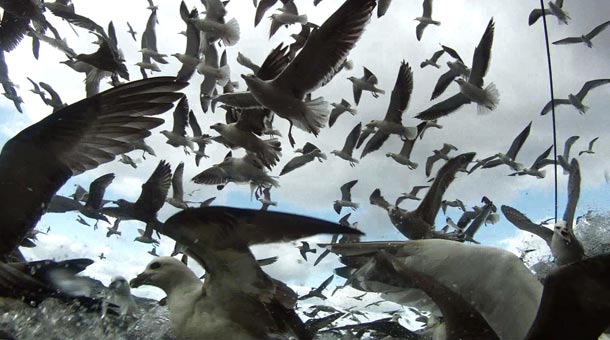
The seagulls of "Leviathan."
There are moments in "Leviathan" so breathtaking that it's easy to forget they're also familiar. Documentarians Vérena Paravel and Lucien Castain-Taylor follow a pair of fishing vessels off the coast of Massachusetts from nearly every imaginable angle as well as a few impossible ones: Captured on small digital cameras fixed to fishermen helmets, tossed beneath the waves and strewn across the deck among the dead-eyed haul, the barrage of visuals populating "Leviathan" contain a routinely dissociative effect. The dialogue is sparse and distant, drowned out by hulking machinery, wind and water. The movie could take place on another planet; instead, it peers at this one from a jarring and entirely fresh point of view.

Your Ad Here A documentary dream team for enthusiasts of experimental approaches to the form, "Leviathan" recalls the strengths of both directors' previous efforts. Castain-Taylor's pensive 2003 look at sheep herders, "Sweetgrass," similarly foregrounded the inextricable bond between humanity and nature, while Paravel turned the grimy discomfort of a Queens junkyard into a marvelously engaging paean to people living at the edges of society. The anonymous fishermen regularly glimpsed throughout "Leviathan" contain a primal dimension drawn out by the way they become almost immediately subsumed by the surrounding environment.
Read more of Indiewire's extensive Locarno coverage

The movie opens with a quote from Job about the unflappable power of the leviathan (the title is later referenced with a sampling of a song by heavy metal rockers Mastadon). But the filmmakers eschew biblical aspirations for raw, cosmic power rendered especially involving by disorientation. Both during the black of night, when the boat forms a piercing figure in the black frame, and in the daylight glow, the camera rarely ever stops moving: From the earliest shots, it constantly shifts from the loud interiors of the boat to view the dark abyss below, resting on blotches of white foam and endowing them with abstract power.

There's little time to adjust before the first of many horrific plunges into the water, where the adventurous, free-romaing lens peers upward before careening to the surface for air. The angles and framing "choices" are as much beholden to a natural ebb and flow as the ocean itself, but the filmmakers thread the images together with brilliant finesse, so that it's often difficult to spot the abrupt editing choices; even more frequently, the montage builds to such an absorbing effect that it's impossible to break the spell and look for them.

Having established the POV of the fishermen, "Leviathan" shifts to the semi-static view of the fish. As cameras lie among the detritus and observe its chorus of vacant stares, the cycle of the fishermen's work is echoed by the rhythmic sounds of chopping and the thud of animal parts hitting the hull as scales glitter among pools of blood.
Even as its perspective grows increasingly alien, 'Leviathan' is full of life.
Despite the overload of sights and sounds, "Leviathan" adheres to a remarkably cogent aesthetic filled with innumerable painterly touches, from the red and blue gloves of the fishermen to the dark yellows of the ship interiors. Flitting across the screen at a relentless pace, the ongoing motion gives the impression of the late Stan Brakhage's dizzying stylings in aquatic terms.

However, the stunt work on display roots the continuing sequence that forms the entire movie in a precise world. "Leviathan" resembles nothing like the existing format for nature documentaries, but it does point to a different approach to it. Generally speaking, the genre is predicated on distance between the viewer and subject. "Leviathan," on the other hand, delves into the thick of it, the camera merging with subjects living and dead, fashioning the natural world into the ultimate expressionistic accomplishment.
READ MORE: 5 Movies to Watch at the 2012 Locarno Film Festival

Your Ad Here Even as its perspective grows increasingly alien, "Leviathan" is full of life. The most striking moment involves a flock of seagulls seen upside down against an empty sky, the digital image morphing them into violent brushstrokes on a blank canvas. The stunning black and white tableaux frees the gulls from a familiar reality while poeticizing their natural buoyancy.

The fishermen are also folded into this reverse objectification. In the lengthiest scene, a middle-aged man rests in the ship interior, neatly framed in a shot that drags on for minutes until he eventually falls asleep. Viewed in his natural habitat, he takes on the same primitive qualities applied to the cold-blooded vertebrae lining the ship.

Without rescinding its atmosphere, "Leviathan" finally brings up its credits, which contain a tribute to vessels lost off the Bedford Coast. Even then, however, it avoids hitting an elegiac note. While ominous, the movie maintains a life-affirming message, celebrating an ancient ritual by plummeting its lyrical depths and staying there.


The Shine of Day(Der Glanz des Tages)
Directed by Tizza Covi, Rainer Frimmel
·         Austria 2012; 90 min
·         Original version: German
·         Genre: Drama
·          
o    Leopard for Best Actor (Walter Saabel), FICC / IFFS Don Quijote Prize & Ecumenical Jury Special Mention - FF Locarno
Your Ad Here


Synopsis

Philipp Hochmair is a young and successful actor working for the most important theaters in Vienna and Hamburg. He spends his time learning new texts, rehearsing and performing, gradually losing touch with everyday reality. But when Philipp meets Walter, with whom he starts an ambiguous friendship, and has to face his neighbour Victor’s destiny, he is reminded that life is more than a stage.
Your Ad Here
Der Glanz des Tages - Tizza Covi, Rainer Frimmel
The film Tizza Covi and Rainer Frimmel festival following the success achieved by the Pivellina is once again a realistic film, semi-improvised and based on how the sudden seriocomica relations between men can change someone's life framed. The encounter / clash between two strong men from the ego: the circus Walter (Walter Saabel directly from the cast of The Pivellina ) and actor Philipp Hochmair who plays a fictionalized version of himself.
Walter's uncle Philipp, the black sheep of the family: the two have never met, but Philipp is still present at the port in Hamburg since Walter called to try to play Woyzeck at the Thalia. Will then start a friendship with his uncle, who had followed him to Vienna, where the actor works caused great excitement at the Burgtheater. Walter ends up sleeping on the couch with the task of Philipp occasionally to take care of neighbors' children because her mother is trapped in Moldova.
Neither man lacks appeal because their is a comparison between two different characters that represent not only recitative style, but also opposing conceptions of freedom.
Philipp is constantly in "arrogant actor," able to find freedom running free in a fit of anger in many different roles; invecchianto and driven by the desire to make amends for its past, Walter moves into a real world that it bears fighting and throwing knives. For Walter freedom (or the glint of the day) is given by just sitting by the river fishing. Jumping from the stage play to private spaces, Covi and Frimmel reveal what happens behind the curtain of everyday life.
Your Ad Here
  
Museum Hours
Directed by Jem Cohen
·         Austria, USA 2012; 107 min
·         Original version: German, English
Your Ad Here
·         Genre: Drama
·          
o    CICAE Art Cinema Award - FF Locarno

Synopsis

When a Vienna museum guard befriends an enigmatic visitor, the grand Kunsthistorisches Museum becomes a mysterious crossroads which sparks the exploration of their lives, the city and the ways art reflects and shapes the world.


Museum Hours

(Austria-U.S.)

A Little Magnet Films, Gravity Hill, KGP Kranzelbinder Gabriele Prod. production. (International sales: MPM Film, Paris.) Produced by Paolo Calamita, Jem Cohen, Gabriele Kranzelbinder. Executive producers, Guy Picciotto, Patti Smith. Directed, written by Jem Cohen.
With: Mary Margaret O'Hara, Bobby Sommer, Ela Piplits. (English, German dialogue)
With the aid of helmer Jem Cohen's focused eye, auds as well as protags learn to view art and the world around them through complementary lenses in the warmly intellectualized "Museum Hours." At once intimate and expansive, the pic uses the chance encounter between a Canadian visitor and a museum guard at Vienna's Kunsthistorisches Museum to explore how it's possible to see transcendence even in the mundane. Results are self-consciously arty yet accessible to those willing to have their minds expanded; fest viewers will happily wile away "Hours" before targeted arthouse play.
Cohen ("Chain") dexterously balances narrative with visual and verbal exposition, training the eye to seek out details and match them with similar elements on canvas and in real life. In a sense, he's taken up the mantle of art historian Aby Warburg, who exhorted his students to find thematic and formal parallels in art as a way of educating the eye toward connoisseurship. Though the helmer occasionally allows a bald didacticism to creep in, it's used as a way of getting viewers to make their own judgments.
Janet (Mary Margaret O'Hara) flies to Vienna after hearing that a cousin is comatose in a hospital. Her first stop in town is the museum, where she asks guard Johann (Bobby Sommer) for directions to the medical center. With repeat museum trips, these two lonely people strike up a platonic friendship, and he even accompanies her on hospital visits.
Your Ad Here
Both are at an in-between stage of their lives, yet the script isn't interested in filling in too much background. They are who they appear to be, opening themselves up after a period of inner focus, and the conduit for this expansion is an appreciation of their surroundings. Cohen juxtaposes closeups of casual objects in a painting, like a broken eggshell, with shots of a discarded cigarette butt or a beer can, guiding the beholder to contemplate the wonder of the small touch; even detritus from a flea market, lying in the slush, becomes an object for consideration, and there's no question that Janet and Johann are stand-ins for the audience as a whole.
It's this minor key that plays out best in the pic, especially when contrasted with the too-explicit verbalization of visiting docent Gerda (Ela Piplits) lecturing to museum visitors about Brueghel. Her gallery talk exhorts listeners to appreciate the artist's cacophony of detail, which famously put his paintings' ostensible subject on the same level as the incidental. The lesson is overstated, and Piplits' delivery artificial (plus, the people cast as her tour group can't act); something a bit less obvious would jive better with the subtlety Cohen demonstrates elsewhere.
Similarly, a fantasy scene of nude museum visitors, coming immediately after Janet remarks on the lack of shame in Lucas Cranach's naked "Adam and Eve," is heavyhanded and inadvertently seems like a parody of a Thomas Struth photograph. Despite such missteps, Cohen's overall strategy is deeply satisfying. He's got a marvelous eye for detail, not just in artwork but in the world around him, and appears to be following Raymond Depardon's style of avoiding picture-postcard sites, and instead bringing out what's notable in the everyday and ignored.
Exteriors were lensed on Super 16, retaining a sense of texture even after their digital transfer; interiors, shot on HD, are clean without being harsh. Minor sequences, such as shifting light within the hospital room, or Janet singing softly to herself, have their own mesmerizing power, yet Cohen knows that nothing will ever beat the wonder of a closeup of Rembrandt's brushwork.